Ends and Pieces
Yesterday, I was messaging with a fellow Substackian about the difficulty of keeping these posts to a reasonable length. My problem, I confessed, was that I always want to quote an author’s well-turned phrase in its entire context, which - of course - increases the length of the piece as I’m simultaneously trying to whittle it down to a size that people will actually read.
But this morning, “lightening struck my brain.” I had “an apostrophe” (long-distance high-five if you can source those quotes) - why not do what those geniuses in the bacon industry have done, and gather up all the delicious ends and pieces - those hunks of salty, smoky deliciousness that are not quite uniform enough to sell as “Bacon Proper” - and plop them down here? Too misshapen to be a proper post, but too good to throw out.
And so this occasional off-the-cuff post idea was born. I’m not sure how often I’ll post “Ends and Pieces” - probably not regularly - but I’ll always title the post as such and give the subtitle over to descriptors so you can see if it’s worth your time.
In keeping with the Bacon theme, it seems appropriate to start our meal of Ends and Pieces with a sizzling Fryeday quote (props to my friend Timilyn for coming up with the clever name/hashtag):
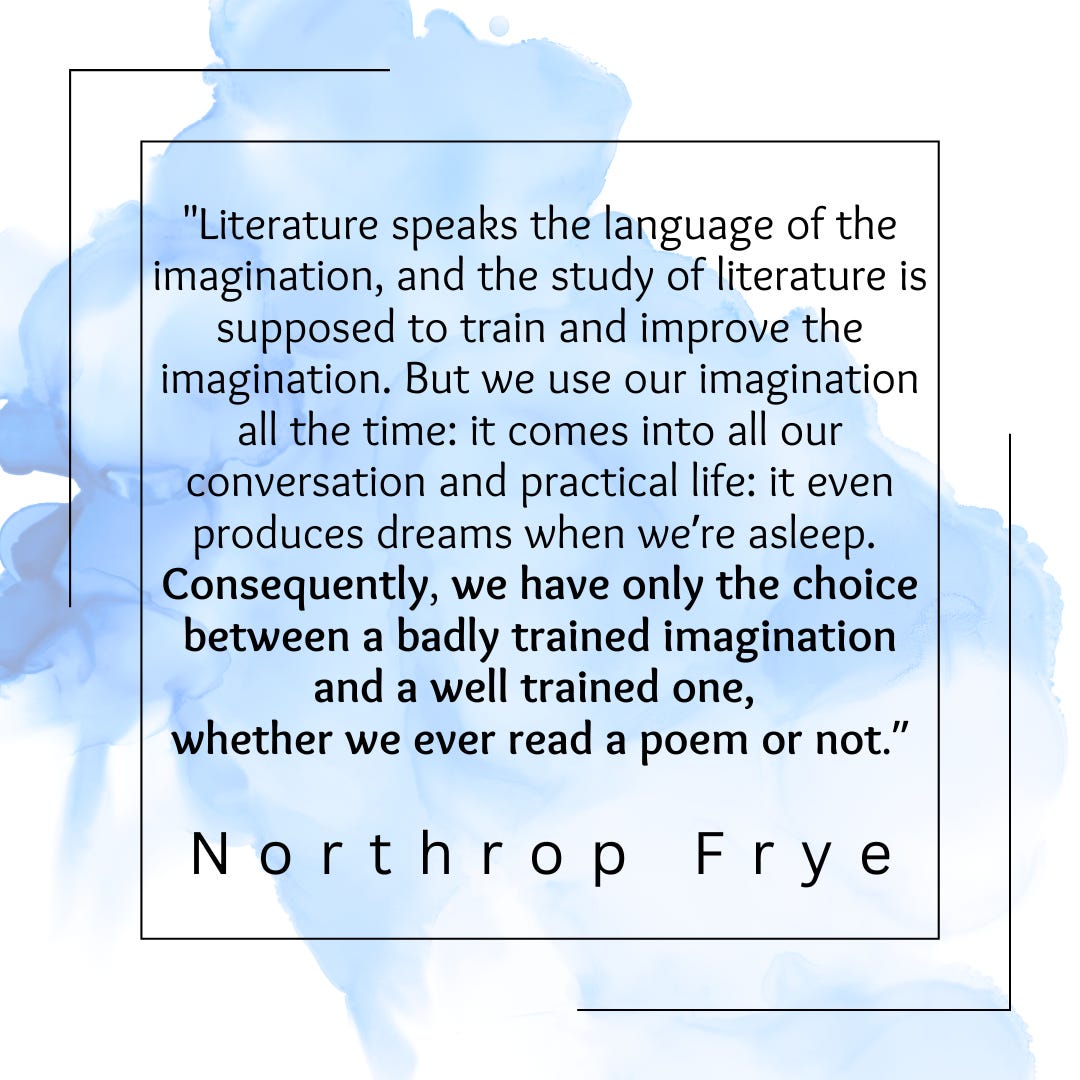
This comes from the final chapter of Northrop Frye’s book The Educated Imagination. (You can listen to the original lectures, which became the book, here.) The entire book is answering the question, “What good is the study of literature?” In six short chapters (the lectures are each only half an hour long) he takes us step-by-step through to his answer, which is that the study of literature is very much necessary because the language of the imagination is in use every day in every type of communication we encounter everyday.
I quoted Frye at length in my rough draft of this week’s post, A Heart that Watches and Receives, but it felt too tangential to the point of the piece (which was why we homeschoolers should quit talking about “the moral imagination” and instead use Charlotte Mason’s phrase “the cultivated imagination”) so I cut it.
But it’s too good not to share! Plus, it connected some of my favorite folks - Wendell Berry, Northrop Frye, Charlotte Mason, C.S. Lewis - with one of my favorite topics: why old books should (maybe must) be included in our children’s education.
Enjoy!
In his essay [on the moral imagination], Russell Kirk says, “…as literature sinks into the perverse, so modern civilization falls to its ruin.”
Northrop Frye agrees. In The Educated Imagination, he writes:
“The fundamental job of the imagination in ordinary life, then, is to produce, out of the society we have to live in, a vision of the society we want to live in. … I don’t see how the study of language and literature can be separated from the question of free speech, which we all know is fundamental to our society. … Nobody is capable of free speech unless he knows how to use language, and such knowledge is not a gift: it has to be learned and worked at. The only exceptions, and they are exceptions that prove the rule, are people who, in some crisis, show that they have a social imagination strong and mature enough to stand out against a mob. …Such people already have what literature tries to give. For most of us, free speech is cultivated speech, but cultivating speech is not just a skill, like playing chess. You can’t cultivate speech, beyond a certain point, unless you have something to say, and the basis of what you have to say is your vision of society.” The vision of society, Frye says, is “a vision inside our minds, born and fostered by the imagination, yet real enough for us to try to make the world we see conform to its shape.” We are back to where we began – the Imagination. And notice that Frye says the imagination is the impulse behind trying “to make the world we see conform to its shape.” That is not simply intellectual assent to an unattainable Utopia. That is imaginative power at work within the citizens of a nation, fueling their desire to live in accordance with a city not yet in existence. And that affects the way they live.
How do we foster and encourage this vision of society? C.S. Lewis gives a worthwhile answer. Speaking about what he calls “the characteristic blindness of the twentieth century,” he says,
“All contemporary writers share to some extent the contemporary outlook—even those, like myself, who seem most opposed to it. … None of us can fully escape this blindness, but we shall certainly increase it, and weaken our guard against it, if we read only modern books. Where they are true they will give us truths which we half knew already. Where they are false they will aggravate the error with which we are already dangerously ill.
“The only palliative is to keep the clean sea breeze of the centuries blowing through our minds, and this can be done only by reading old books.”
The imagination, like a muscle, must be stretched and exercised to give it strength to carry us beyond ourselves and our “contemporary outlook.” We stretch and exercise our mind in all its capacities by reading old books that are written outside our modern language and thus our modern way of thinking. Old books provide us with the kind of detachment necessary to think about things in both an abstract or ideal way as well as a concrete way. We don’t read old books for the charm of another time only, but also and more so for the perspective of our own time within Time.
In another essay called The Instruments of Mental Production, Frye says that the humanist education begun in the Renaissance was successful because they were able to look at the classical societies of Rome and Greece as an ideal model, and because they were able to observe it in its ideal form, they were able to shape their culture toward that ideal. Their imaginations had grasped something to direct their imaginative efforts toward, and a humane education was the result:
“The Renaissance, then, carried on the traditional conception of education as a vision of the just state, but it had ready at hand a powerful practical method of achieving it. This was humanism, the study, not of an ideal civilization, but of an actual one which, having disappeared, could be studied in its ideal form as a structure of arts and sciences. ... The genuine humanists studied the classics, not as immutable cultural forms in another world, but as informing cultural principles in their world. The classics, in their totality, including Vitruvius on architecture and Columella on agriculture as well as Virgil and Cicero, made up a coherent structure of knowledge that, properly applied, could transform Renaissance society into something like its own pattern of coherence, as the ‘embers of dead tongues’, in Milton’s phrase, kindled a new flame, and the old Roman Empire became renewed into the Holy Roman Empire, the temporal power of Christian Europe. At its best, the study of classical culture promoted a liberalism of outlook that might otherwise have been impossible in ages so heavily burdened with religious and political anxieties. The Greek and Roman cultures could be studied with a genuine detachment, as the student was committed neither to their religions nor to their political views, and hence was able to separate the ideal or permanent structure from the historical one.”
In the same essay, he writes:
The editor of Shakespeare and the chemist live in different scholarly worlds, and proposals to make the humanist memorize the second law of thermodynamics and the scientist a speech from Macbeth will not bring them together. What brings them together is social, not intellectual, the fact that they are both citizens of their society with a common stake in that society. The only knowledge that is worth while is the knowledge that leads to wisdom, for knowledge without wisdom is a body without life. But no form of knowledge necessarily does or cannot do that: the completing of the structure has something to do with one’s sense of the place of knowledge in the total human situation, ideal as well as actual."
Wendell Berry, in Health is Membership, said, “ Knowledge refers to the ability to do or say the right thing at the right time. …’Information,’ which once meant that which forms or fashions from within, now means merely ‘data.’ However organized this data may be, it is not shapely or formal or in the true sense informing. It is not present where it is needed; if you have to ‘access’ it, you don't have it. Whereas knowledge moves and forms acts, information is inert. You cannot imagine a debater or a quarterback or a musician performing by ‘accessing information.’ A computer chock full of such information is no more admirable than a head or a book chock full of it.” This knowledge in action and informed (formed inwardly) by the social vision of the Imagination - of the cultivated Imagination - completes the structure of knowledge and unites people from all branches of knowledge in their “common stake” as it justifies their scholarly learning by providing a “sense of the place of knowledge in the total human situation, ideal as well as actual.”


Comments
Post a Comment