Living Among the Ruins - thoughts on "repairing the ruins" of one's education
"The world is divided into persons who read and think
and persons who do not read and think…"
Charlotte Mason
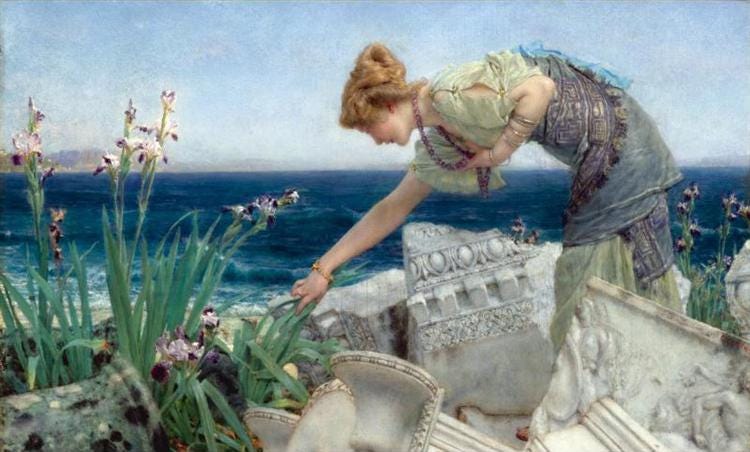 |
| Among the Ruins, Sir Lawrence Alma-Tadema |
“Youth is wasted on the wrong people!”
As a kid, I thought the old man who shouted this line in It's a Wonderful Life was just a grumpy curmudgeon, but thanks to age and experience, I realize just how right (and how not old) this side-character is. Youth is wasted on the wrong people. But so is every other stage and experience in life. We only begin to appreciate what we had, what we could have done, what we should have done, with the clarity of distance and detachment. When we are further down the road, away from in-the-moment concerns - like the fear of failing and looking like an idiot, or rejection, or the lack of self-awareness that results in proud unteachability - we can see all the opportunities we had and wasted. Education falls under this umbrella.
I wasted my time in school. Yes, I learned things, but not the things that I now wish I knew. When I am reading an essay or a biography, or homeschooling my kids and we both learn something together, I have a moment of sadness and longing, mixed with a little bit of anger: “Why did no one teach me this? Why am I only learning this now?”
Some hurdles for the self-educator
The idea that education happens when we go to school is our first hurdle. I don't mean to say that whatever the schools are doing, it's not educating - though clearly I agree with that general sentiment since I've spent the last 15 years homeschooling my kids with a method that actively rejects factory-model education. What I mean is that we seem to have an unarticulated assumption that real learning begins when we enter kindergarten and ends when we graduate from whatever institution we last went to. Homeschooling parents can operate under this belief, too. No-one is immune.
Some folks (like me) are lucky enough to have had a parent or parents who believed that all of life is worth learning about all life long. They model, preach, encourage curiosity and appreciation of details to their kids and grandkids. They can’t help it; they are actually curious and interested people. They encourage staring as a habit and as the first step to becoming acquainted with more of the world/life/reality. They believe, though they may never articulate it, what my friend Anne wrote in a recent post, that “…the only person responsible for their education is the individual.” This echoes Charlotte Mason: “there is no education but self-education.”
…the children, not the teachers, are the responsible persons; they do the work by self-effort.” (A Philosophy of Education, p. 6)And
The world is divided into persons who read and think and persons who do not read and think; the business of schools is to see that their scholars shall belong to the former class; and it is worth while to remember that thinking is inseparable from reading which is concerned with the content of a passage and not merely with the printed matter. (The Parents’ Review, 1913, pp. 498–507)The second hurdle is often our own attitudes toward our ignorance. The life of the self-educated person (or the “autodidact”) is a life of chosen humiliation. Not humiliation in the sense of being put down or made fun of, with all the attention on you and your failure to measure up. It is humiliation in the archaic sense of making one humble. The self-educating person has to admit over and over how much they don’t know, and in this moment of admission there always follows a choice. Either the self-educator can become tired of admitting ignorance and focus on how uncomfortable it is to not know something (or many things) which will lead to the end of her learning experience by shifting her focus from all there is to know to her own lack of knowing, or she can lean into the awareness of ignorance and choose to let it show her how big the world is, how multilayered and multifaceted, how many trailheads she has in front of her, all the potential journeys waiting for her. She can decide to either be defeated or excited.
This is where the real repairing begins. We can see the massive task before us and decide it is too great an endeavor and quit before we start, or we can see the massive task before us and decide it is too great an endeavor to postpone any longer and spend the rest of our lives working at it.
The third hurdle is a close cousin to the second: to see the work as tedious and pointless; we’ll never finish the work before we die so what’s the point? We aren’t going to win any accolades or make any money at it so why bother?
Again, this hurdle offers a choice, to measure the value of our self-education by what we can get materially from it or we can see the work itself as valuable, as wonder-full and exhilarating; we’ll never finish the work before we die, so let’s make the most of the time we have left. Who cares if we win accolades or make money? The learning is the reward. It makes our world bigger even as it makes us feel smaller. It shrinks our own selves in our thinking and yet makes us more capacious; we expand inwardly as we shrink in our own estimation. I think this is because learning feeds wonder and wonder increases our capacity to carry greater loads of goodness within us. As we forget ourselves, we focus on what we want to learn, not realizing the work that outward focus is doing in us.
The fourth hurdle is time. How do we want to spend our free time? We live in a culture devoted to entertainment and comfort. The self-educator has to choose almost daily between entertainment and education. There is nothing inherently wrong with entertainment, but it is easier to choose a movie over Latin declensions. This is a hurdle that takes judgement to cross. Sometimes, we need the break. A time to digest always follows a feast. A season of relaxation is a part of the self-educating life. We can’t always be taking in. Sometimes we need to enjoy and give our minds a chance to rest and recover. The temptation comes in making a habit of entertainment. We have to be our own school-masters. We have to be willing to say, “Time to resume your studies,” and then, like a good student, admit the wisdom of our teacher and get back to work.
Conclusion
In A Philosophy of Education, Charlotte Mason wrote:
“The function of schools is no doubt to feed their scholars on knowledge until they have created in them a healthy appetite which they will go on satisfying day by day throughout life.” (emphasis mine)
Many of us might say that our schools failed us, that we are just now discovering an appetite for knowledge and we are both starving and discouraged. But there is no time like the present to begin. A healthy appetite is a sign of wellness returning to the body. A healthy appetite for knowledge is a sign not only of a healthy mental state, but a soul that is alive and well, too. The ruins are real, but to live among them - admiring them, rebuilding them, growing in strength of soul and love to God - is no bad thing.
The end then of learning is to repair the ruins of our first parents by regaining to know God aright, and out of that knowledge to love him, to imitate him, to be like him, as we may the nearest by possessing our souls of true virtue, which being united to the heavenly grace of faith makes up the highest perfection.
John Milton


Comments
Post a Comment