I am a little machine cunningly made; thoughts and questions about modern metaphors
Before I begin, a disclaimer: I'm not linguist or a philologist. I'm not an expert of any kind when it comes to language (or anything else), so I’m not going to attempt to inform you of anything you don't already know. Hopefully this is a relief to you. My goal is to narrate some questions and observations that came to mind as I thought about this one sentence and practice articulating the implications I see about language and meaning and how metaphors inform our understanding of ourselves as human beings. By sharing it here, I’m inviting you to think with me about these things. If you have insights, feel free to share them in the comments.
"The human brain is a prediction-making machine and it wants to make predictions on the basis of things that feel reliable."
The host of a prominent science podcast said this in passing on one of his recent episodes. I immediately stopped and skipped the episode back a few seconds to hear the sentence again.
"The human brain is a prediction-making machine and it wants to make predictions on the basis of things that feel reliable."
The brain is a machine and it wants.
This is a startling statement to me, and a clear example of the way we think about ourselves as moderns in the machine age.
The first half of the sentence is a metaphor:
"The human brain IS a predicting-making machine..."
"The brain is a machine."
Not "the brain is like a machine," but a "this is that" statement. What is a metaphor? The dictionary has a definition, but I think Northrop Frye is more helpful here:
"There are two main kinds of association [language], analogy and identity, two things that are like each other and two things that are each other. You can say with Burns, 'My love is like a red, red rose,' or you can say with Shakespeare:
Thou that art now the world's fresh ornament
And only herald to the gaudy spring.
One produces the figure of speech called the simile; the other produces the figure called metaphor."
(Northrop Frye, The Educated Imagination, emphasis mine)
To say the brain is a machine is to communicate something about the brain through use of a metaphor. A metaphor is not a statement of fact, but a statement of association and identity that goes beyond the actual. The brain is not actually any kind of machine. We all know this. Or we used to. It's more doubtful now whether we would all still agree on that assertion. The scientist and his audience know it is. Or I hope they do. They should know it. But why does it matter if they do or not, or if we know it or not? Because of that little phrase in Frye’s explanation, "analogy and identity." Northrop Frye again,
"In descriptive writing you have to be careful of associative language. You'll find that analogy, or likeness to something else, is very tricky to handle in description, because the differences are as important as the resemblances."
(The Educated Imagination)
In a tweet last year, Elon Musk refer to the brain as a "meat computer" -
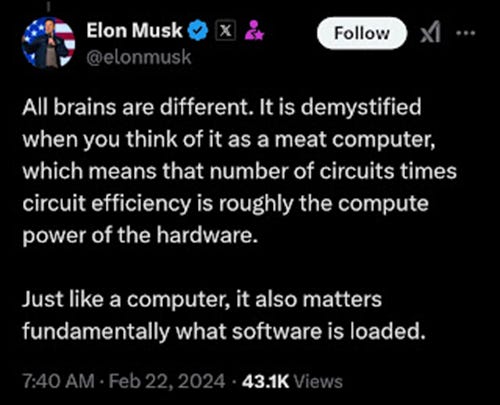
Here he is using the language of simile, not metaphor, so the statement he is making is not quite “this is that”, though you could say that the phrase “just like” implies the “this is that” of metaphor. But even if it isn’t quite to the level of metaphor, it is still the language that Frye warns "is very tricky to handle in description." The reason is that we could take it beyond the level of association to identification without even realizing we are doing so. If we think of our brain as a glorified computer, we are not far from thinking of the rest of ourselves as glorified machinery, and not machinery as parts of a whole, but as individual machines in containers of bone and flesh.
This could just be an example very smart people using less-than-ideal metaphors to zero in on the brain's incredible ability to accomplish tasks that would take many, many machines to do in its place. According to the John Hopkins website, "The brain is a complex organ that controls thought, memory, emotion, touch, motor skills, vision, breathing, temperature, hunger and every process that regulates our body." A lot more than just computing or prediction-making is going on in the human brain, and of course the host of the science podcast I quoted at the beginning of the piece knows this; as a neurobiologist, he has probably forgotten more about the brain and its many functions than I as an uneducated homeschooling mom will ever know. This is not meant as a corrective in any way to him or his approach to his area of expertise. What he said in passing was simply a well-expressed example of the way we use language every day without thinking much about it. But in that little statement I think there is potential to see some foundational assumptions on which we are building our 21st century metaphors, and consequently our 21st century definitions and beliefs about what it means to be human. Pope John Paul II said, “As goes the family so goes the nation.” I’m wondering if as goes the metaphors so goes our humanity.
Look at the second part of the sentence:
"...and it wants to make predictions on the basis of things that feel reliable."
Here the sentence jumps from a metaphor (which seems to me to have moved beyond association and metaphor to an authoritative statement of fact in our culture, but that's probably a different post) to language assigning emotion and will to the prediction-making machine. The brain wants, it desires. And it desires something based on a considered feeling of determined reliability, something that is itself a process of analysis and judgement that is a very human internal event.
The machine wants. Several R.S. Thomas poems immediately come to mind.
The reason this seems important to me is that the choice of metaphors we use to speak about ourselves could potentially change our culture’s underlying assumptions that make up how we see and understand both parts of the metaphor. Or maybe they mark a change already happening. In this metaphor, the brain is not a complex organ of regulation within a person, it is not a biological part of a person; the brain is a machine with a will and preferences of its own. It is now isolated from the person carting it around. The metaphor is a bridge between two unlike things, but in bridging the brain and the machine, it leaves out the rest of the person, because a machine is a self-contained unit. It is not a part of the world around it as a fox or a wave or a breeze is part of the world. It needs a power source and an operator. It is itself in isolation from everything else. The brain is not, but we talk about it like it is and so end up thinking about it like it is. I think this brings us back to Frye saying that in analogy, “…the differences are as important as the resemblances.”
We often talk this way. It is sloppy language, but being a modern person, I talk this way and don't think much about it in the moment. I talk about not having enough bandwidth for things, or needing to push the reset button, etc. When I stop to consider the language I’m using and find myself criticizing or questioning it, I feel a bit sheepish, like I’m being overly nit-picky. We seem as a culture to doubt that metaphors like this mean anything more than that we live in a machine-making world so of course our metaphors will become mechanical. Possibly that’s true and overthinking this. But we didn’t always talk about ourselves this way. We have moved a long way from Donne’s sonnet that begins with the metaphor:
“I am a little world made cunningly
Of elements and an angelic sprite…”
A machine does not have the same emotional weight as a little world full of life and variety and strangeness; the machine itself is uniform and in-animate, i.e., without life or, more accurately, without soul. Do these kinds of metaphors affect our understanding of what it means to be human at a presuppositional level? This is what I’m wondering about here.
How does a metaphor work? Is it from a greater to a lesser? Jesus says, "I am the door," and "I am the vine," but can the door or the vine say, "I am the Savior; I am the Son of God” in the same way? It doesn’t seem like it. The vine could say, "I am like Christ" but it could not set itself as encompassing the essence of the object it is relating itself to, which seems to be what a metaphor does. “Truth is the key to a happy life.” Truth is not an actual key, but it has qualities or traits that can best be expressed by a key, or maybe the keyness of the key, those things true of every key and not only of a specific key. We know truth is not made of metal or bone, it will not unlock actual locks, it doesn’t have the same potential to be misplaced that a real-life key has. And yet in that metaphor something true is said about Truth by relating it to a key, the differences notwithstanding. The same is happening in the biblical metaphor, “The church is the body of Christ.” Paul uses the language of living members of a single creaturely body to bring into focus the unique unity that is a defining characteristic of the church. We are knit together (another metaphor) in a way that resembles the living tissue of a healthy human body. But it is unity that goes beyond what is expressed by the human body, because this unity will never decay or dissolve as our bodies eventually will. This is what I mean by the greater uses the lesser in a metaphor. “The heart is a pump.” The heart is no longer thought of as an organ of the body which functions like a pump; the heart is a pump. We think of it as a pump. It has been reduced and equated to something lesser. Does a metaphor always do this?
When we use complicated machine-based metaphors for ourselves, do we risk accidentally developing a sympathy toward machines because we have connected ourselves to them in an intimate, personal way? When we anthropomorphize animals, our emotional responses toward them are elevated to a human-to-human kind of response. It doesn’t seem possible to me to say “this is that” without leaving some kind of sympathetic residue behind. "The brain IS a prediction-making machine..." We say it is a machine, and then we speak about its desire to do something. In that moment have we turned the metaphor inside out, or backwards? Is it possible that lines of identity will be blurred? Could we move from the machine no longer reflecting a part of us, as the door (which is a simple machine) reflects something of who Christ is, but that we now reflect aspects of it? It now has personality, maybe even personhood, apart from us. It wants and desires things that were unknown to us.
Considering metaphors more broadly, when I say something like "trees stand like soldiers," in my mind the focus shifts from the trees to pictures or experiences of seeing rows of soldiers, ready for combat, and I say, "Ah yes, the trees do stand like that." But can I say, “The trees are soldiers standing in formation"? If I do, something beyond standing in formation seems to be intended. The focus is not on the trees standing tall or in military formation but on the trees as soldiers, with the martial implications. This metaphor is saying something beyond itself. In this example, I’m left with the impression that the created world has a combative, martial response that the trees especially embody. (Hello, Tolkien’s Fangorn Forest.)
Like I said at the beginning, I don’t have answers; just questions and observations and attempts at articulation. It’s surprisingly difficult to talk about language with language. But it seems worthwhile to step back and consider how modern metaphors have the potential to inform (as in, inwardly form) our understanding of ourselves, either as little worlds made cunningly, or as meat computers and prediction-making machines in containers of congealed calcium and amino acids.
I’ll end with Frye and a poem by R.S. Thomas:
"As for metaphor, where you're really saying 'this is that,' you're turning your back on logic and reason completely, because logically two things can never be the same thing and still remain two things. The poet, however, uses these two crude, primitive, archaic forms of thought in the most uninhibited way, because his job is not to describe nature but to show you a world completely absorbed and possessed by the human mind. So he produces what Baudelaire called a 'suggestive magic including at the same time object and subject, the world outside the artist and the artist himself.' The motive for metaphor according to Wallace Stevens, is a desire to associate, and finally to identify, the human mind with what goes on outside it, because the only genuine joy you can have is in those rare moments when you feel that although we may know in part, as Paul says we are also a part of what we know." The Educated Imagination
Once
by R.S. Thomas
God looked at space and I appeared,
Rubbing my eyes at what I saw.
The earth smoked, no birds sang;
There were no footprints on the beaches
Of the hot sea, no creatures in it.
God spoke. I hid myself in the side
of the mountain.
As though born again
I stepped out into the cool dew,
Trying to remember the fire sermon,
Astonished at the mingled chorus
Of weeds and flowers. In the brown bark
Of the trees I saw the many faces
of life, forms hungry for birth,
Mouthing at me. I held my way
To the light, inspecting my shadow
Boldly; and in the late morning
You, rising towards me out of the depths
Of myself. I took your hand
Remembering you, and together,
Confederates of the natural day,
We went forth to meet the Machine.


Comments
Post a Comment