The Echo and the Longing - Nature and C.S. Lewis’s Weight of Glory, Inner Ring, and Membership essays
“The Heavens declare the glory of God;
And the firmament shows His handiwork.
Day unto day utters speech,
And night unto night reveals knowledge.
There is no speech nor language
Where their voice is not heard.
Their line has gone out
Through all the earth,
And their words to the end of the world.” Psalm 19:1-4
“For as the rain comes down, and the snow from heaven,
And do not return there
But water the earth,
And make it bring forth and bud,
That it may give seed to the sower
And bread to the eater,
So shall My word be that goes forth from My mouth;
It shall not return tome void,
But it shall accomplish what I please,
And it shall prosper in the thing for which I sent it.” Isaiah 55:10-11
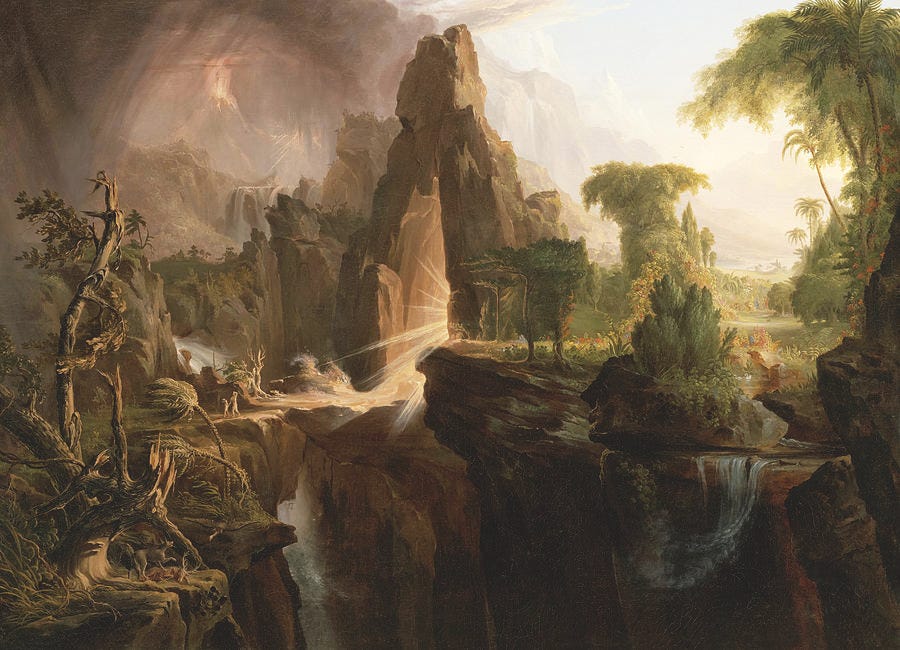 |
| ‘Expulsion from the Garden of Eden,’ Thomas Cole |
Around the start of every new year, I reread C.S. Lewis’s essay, The Weight of Glory. If you are at all familiar with this essay, you will understand why. And if you are not familiar with this essay, acquaint yourself as soon as you possibly can. It is a work of sincere eloquence.
This year, I noticed for the first time that the way Lewis talks about Nature and our relation to Nature in The Weight of Glory (WG) is exactly how he talks about our relation to each other socially, in the essays The Inner Ring (IR) and in Membership (M). This new-to-me connection gave a fresh emphasis to what I have long believed to be true: that the way we relate to and interact with Nature ultimately depends on the way we relate to God Himself. I’m not equating God and Nature; Nature, like us, was made and what is made is not the Maker. What I hope to convince you of by the end of this piece is that Nature is to us either “as a fond mother,”1 or, as J.C. Shairp puts it, “an all-devouring Sphinx,”2 and that relationship is totally dependent on how we relate to our Maker, Jesus Christ.
In WG, Lewis talks a lot about Beauty and the way it affects our perception of both ourselves and the thing beautiful. Part of what makes this essay worth reading again and again is that, in typical Lewisian fashion, he names so precisely, so exactly, what many if not all people have felt but which we don’t usually talk about: the deep, abiding sense of longing and left-outness brought about by experiences of Beauty, and particularly Natural Beauty.
“One of [our spiritual longings’] most curious characteristics… [is usually noticed] just as the moment of vision dies away, as the music ends, or as the landscape loses the celestial light… You know what I mean. For a few minutes we have had the illusion of belonging to that world. Now we wake to find that it is no such thing. We have been mere spectators. Beauty has smiled, but not to welcome us; her face was turned in our direction, but not to see us. We have not been accepted, welcomed, or taken into the dance. We may go when we please, we may stay if we can: ‘Nobody marks us.’”
This feeling of being left out is exactly what Lewis says we experience in when confronted with ‘the Inner Ring’:
“You discover gradually, in almost indefinable ways, that it exists and that you are outside it… To discuss it with other outsiders would make you feel outside yourself.”
This corresponds to what Lewis says in WG about the longing felt after experiencing beauty: “In speaking of this desire for our own far-off country, which we find in ourselves even now, I feel a certain shyness. I am almost committing an indecency. I am trying to rip open the inconsolable secret in each one of you – the secret which hurts so much that you take your revenge on it by calling it names like Nostalgia and Romanticism and Adolescence - the secret also which pierces with such sweetness that when, in very intimate conversation, the mention of it becomes imminent, we grow awkward and affect to laugh at ourselves; the secret we cannot hid and cannot tell, though we desire to do both.”
What is this secret? “Our commonest expedient is to call it beauty and behave as if that had settled the matter,” Lewis says, but beauty doesn’t quite name it. Beauty is harmony of form and substance, all things in proportion, and it is not this harmony itself that hurts and pierces. It is more like the echo of the harmony. As Lewis say, “[this secret] was not in them, it only came through them, and what came through them was longing.” (emphasis mine)
Lewis is describing exactly what George Herbert wrote about in his poem, The Pulley:
When God at first made man,
Having a glass of blessings standing by,
“Let us,” said he, “pour on him all we can.
Let the world’s riches, which dispersèd lie,
Contract into a span.”
So strength first made a way;
Then beauty flowed, then wisdom, honour, pleasure.
When almost all was out, God made a stay,
Perceiving that, alone of all his treasure,
Rest in the bottom lay.
“For if I should,” said he,
“Bestow this jewel also on my creature,
He would adore my gifts instead of me,
And rest in Nature, not the God of Nature;
So both should losers be.
“Yet let him keep the rest,
But keep them with repining restlessness;
Let him be rich and weary, that at least,
If goodness lead him not, yet weariness
May toss him to my breast.” (emphasis mine)
Lewis says in prose what Herbert put in poetry and what St. Augustine famously said in his confessions: “Thou hast made us for Thyself O God, and the heart of man is restless until it finds its rest in Thee.” Augustine also wrote that,
“Longing is the very bosom of the heart. We shall attain, if with all our power we give way to our longing. Such in our behalf is the object of the divine Scriptures, of the assembling of the people, of the celebration of the sacraments, of holy baptism, of singing God's praise, and of this our own exposition — that this longing may not only be implanted and germinate, but also expand to such a measure of capacity as to be fit to take in what eye has not seen, nor ear heard, nor has entered into the heart of man.” Tractates on the Gospel of John, 40.10
Augustine makes it sound as though God purposes us to long through all the avenues of worship, and that we were made for longing, for yearning and awe and wonder, all those emotions that take in things as vast as a sky filled with stars or a mountain vista or the detailed patterns of a tiny seashell. Augustine says that the object of this holy longing is not for it to be satisfied but that it may “also expand to such a measure of capacity” that we can take in those uncreated glories these things allude to. To put in terms appropriate to this discussion, as we take in the beauty of the natural world, the wonder and longing we feel increases our capacity to hunger for more than the beauty of the natural world holds.
The trouble is that this enjoyment cannot be reciprocated; we can’t be taken in by them. I can’t become part of the starry heaven while I’m myself in this time and place. All the longing and awe and wonder in the universe can’t make that happen. We feel our outsider status; it hurts. “We pine,” writes Lewis. “The sense that in this universe we are treated as strangers, the longing to be acknowledged, to meet with some response, to bridge some chasm that yawns between us and reality, is part of our inconsolable secret.” WG
When I read this, I was immediately reminded of a passage in IR where Lewis writes, “I believe that in all men’s lives at all periods between infancy and extreme old age, one of the most dominant elements is the desire to be inside the local Ring and the terror of being left outside.” (emphasis mine) We all long to some degree, he says, to have “the delicious knowledge that we…are [part of] the people who know.”
Lewis is careful to emphasize he is not saying “the existence of Inner Rings is an evil. It is certainly unavoidable. There must be confidential discussions, and it is not only not a bad thing, it is (in itself) a good thing that personal friendship should grow up between those who work together… It is necessary, and perhaps it is not a necessary evil. But the desire which draws us into Inner Rings is another matter.” The thing itself is not evil. It is our response to it that leads us astray. “Let Inner Rings be an unavoidable and even an innocent feature of life, though certainly not a beautiful one; but what of our longing to enter them, our anguish when we are excluded, and the kind of pleasure we feel when we get in?” Lewis says that what we are ultimately after, at the bottom of the desire, at the root of the longing is “the delicious sense of secret intimacy.”
But he also says that this is a longing which can never be met in the way we naturally try to meet it. We cannot truly penetrate the social Inner Rings, and if we try to we are guaranteed to fail:
“As long as you are governed by that desire [to get in] you will never get what you want. Until you conquer the fear of being an outsider, an outsider you will remain.”
This is because an Inner Ring is only desirable from the outside: “…if all you want is to be in the know, your pleasure will be short-lived. The circle cannot have from within the charm it had from outside. [Because] you were not looking for virtue or kindness or loyalty or humour or learning or wit or any of the things that can be really enjoyed. You merely wanted to be ‘in.’ And that is a pleasure that cannot last.” Add to that that “your genuine Inner Ring exists for exclusion. There’d be no fun if there were no outsiders… Exclusion is no accident; is it the essence.”
If you ever had the opportunity to join the cool kids table at school, you know this is true. The appeal is entirely outside, and what keeps you in is not purely affection for the people in the group, but partly a fear of being Outside and a solitary, self-stroking pleasure at knowing you are In when others are not.
This longing, to be intimately known and acknowledged and seen and invited into something is part of what Nature is meant to awaken in us:
“Apparently, then, our lifelong nostalgia, our longing to be reunited with something in the universe from which we now feel cut off, to be on the inside of some door which we have always seen from the outside, is no mere neurotic fancy, but the truest index of our real situation. And to be at last summoned inside would be both glory and honour beyond all our merits and also the healing of that old ache.” WG
The desire for acceptance in an Inner Ring speaks to our human need for belonging and companionship. Our aesthetic sense moves us to feel exquisite joy, so sharp it is almost painful, at something like a sunset. We wish it could go on forever and that we would be always drinking it in. But even if we could gaze at it forever, the longing would eventually return because we can’t have friendship with a sunset. The desire to be ‘in’ is really a desire for intelligent, reciprocated relationship with those like us, or with those whom we admire.
The problem with this as Lewis describes it is that as long as it is a desire centered on my status, it is a desire that is full of me. In a longing to be “in” with a certain group, there is a constant measurement of myself taking place. It is a lust, rather than a longing, for lust always has a self-concern and a component of fear that true longing does not have. In lust, I am always in my thoughts. But in the longing to become part of the beauty I see, I am not in my thoughts at all, or if I am, it is that I could be something other than what I am, something better, that I could get beyond myself. The desire for the inner ring does not move me to wish I were more pure or more virtuous. It moves me to wish that those ‘inside’ recognized the value I see in myself. What I am really seeking is glorification.
Lust is always a twisting of a good desire, and I think that is the case here. We long for intimacy with other people. Not a romantic intimacy that allows for only two members, but a more familial intimacy. We long for membership, for belonging. In his essay on Membership (M), Lewis contrasts the individual and the collective secular community with the membership of the mystical Body of Christ, the Church. This is what I think both the longing for the Inner Ring and the longing to be united to Beauty are mutually goading us toward: “How true membership in a body differs from inclusion in a collective may be seen in the structure of a family… [The members] are not interchangeable. Each person is almost a species in himself… If you subtract any one member, you have not simply reduced the family in number; you have inflicted an injury on its structure. Its unity is a unity of unlikes, almost of incommensurables.”
This is found through the entire Body, from toe to Head:
“The society into which the Christian is called at baptism is not a collective but a Body. It is in fact that Body of which the family is an image on the natural level. If anyone came to it with the misconception that membership of the Church was membership in a debased modern sense – a massing together of persons as if they were pennies or counters – he would be corrected at the threshold by the discovery that the head of this Body is so unlike the inferior members that they share no predicate with Him save by analogy. We are summoned from the outset to combine as creatures with our Creator, as mortals with immortal, as redeemed sinners with sinless Redeemer. His presence, the interaction between Him and us, must always be the overwhelmingly dominant factor in the life we are to lead within the Body, and any conception of Christian fellowship which does not mean primarily fellowship with Him is out of court…
“The structural position in the Church which the humblest Christian occupies is eternal and even cosmic. The Church will outlive the universe; in it the individual person will outlive the universe. Everything that is joined to the immortal head will share His immortality. … There will come a time when every culture, every institution, every nation, the human race, all biological life is extinct and every one of us is still alive. Immortality is promise to us, not to these generalities. It was not for societies or states that Christ died, but for men. … But then it is not the individual as such who will share Christ’s victory over death. We shall share the victory by being in the Victor. … As mere biological entities, each with its separate will to live and to expand, we are apparently of no account; we are cross-fodder. But as organs in the Body of Christ, as stones and pillars in the temple, we are assured of our eternal self-identity and shall live to remember the galaxies as an old tale.”
This parallels a passage in WG: “You must not think that I am putting forward any heathen fancy of being absorbed into Nature. Nature is mortal; we shall outlive her. When all the suns and nebulae have passed away, each one of you will still be alive. Nature is only the image, the symbol; but it is the symbol Scripture invites me to use. We are summoned to pass in through Nature, beyond her, into that splendour which she fitfully reflects.”
The first chapters of Genesis tell us how it is that we feel a kinship with creation and yet seem to be hopelessly, impossibly excluded. It’s because we excluded ourselves. In Adam, our representative head, we were exiled from not only the physical garden, but from the existential experience of unity with all living things and from friendship with God. We were in; we chose to be out. The first lie Eve heard was to be in the Inner Ring of the people who know: “Did God really say?” The only Inner Ring that matters - if I can speak of something so glorious and holy as the Trinity as an Inner Ring - the one every Inner Ring is aping, our First Parents rejected, and in their place we would have done no different. It is any wonder that we have inherited this longing to get back to the garden, to that harmonious existence between us and Nature and our mutual Maker? Is it any wonder we don’t like to speak of it? We are like Alice, desperate to get to the beautiful garden we see through the keyhole and at risk of drowning in a sea of tears because we just aren’t able.
Nature is no disinterested party in this. She wants us to ‘get in.’ Indeed, she has much to gain from it. Scripture says that creation knows her release from the curse we both share (a good reminder that sin always ruins more than just the one who commits it) relies on our coming into our inheritance:
“For creation waits with eager longing for the revealing of the sons of God…For we know that the whole creation has been groaning together in the pains of childbirth until now. And not only the creation, but we ourselves, who have the firstfruits of the Spirit, groan inwardly as we wait eagerly for adoption as sons, the redemption of our bodies. For in this hope we were saved.” Romans 8:19, 22-24
The role of creation, in part at least, is to teach us to groan.
Lewis says that “we want something else which can hardly be put into words – to be united with the beauty we see, to pass into it, to receive it into ourselves, to bathe it, to become part of it.” The longing to be united with beauty is only because on some level we know that we are not beautiful ourselves. The longing to be in is because we know we are out. Both are the desire of the lesser to the greater. But the longing we experience through creation is also called Joy by Lewis because it has a fragrance of hope. We can get in. We are being invited into a relationship with our Maker, into the true and good Inner Ring; the Triune God is every day inviting us into relationship with Him through Christ (who says, “I am the Door”) and the beauty of Nature is summoning us to listen.
This is what the echo and the longing really are – an invitation and a summons, repeated and echoing through all Nature. The echo of “I shall put enmity between” and “cursed is the ground for your sake” is like a brand on every particle of creation. Somewhere in the world, the footprints of those driven from the garden and the scorch-marks from the flames of its entrance guarded are still there. But God allows flowers to grow beside thistles. He teaches Adam how to sow and reap. Mercy is everywhere, tempering our curse; “It droppeth as the gentle rain from heaven.”3 Mixed with the echoes of exile, there is a tender refrain, a invitation to come home:
“Come unto Me all ye who labor and are heavy laden and I will give you rest.”
Nature does not make this promise; she knows rest is not one of her treasures to give. But she does sharpen our ears to hear it, and longing is her way of doing it. She is the keyhole through we see the garden, that place where “the whole man is to drink joy from the fountain of joy.” Christ, though, is the Door; when we knock, He opens, welcomes us in, and bids us drink our fill.
“At present we are on the outside of the world, the wrong side of the door… But all the leaves of the New Testament are rustling with the rumour that it will not always be so.
Some day, God willing, we shall get in.”
Nature
by Henry Wadsworth Longfellow
As a fond mother, when the day is o'er,
Leads by the hand her little child to bed,
Half willing, half reluctant to be led,
And leave his broken playthings on the floor,
Still gazing at them through the open door,
Nor wholly reassured and comforted
By promises of others in their stead,
Which, though more splendid, may not please him more;
So Nature deals with us, and takes away
Our playthings one by one, and by the hand
Leads us to rest so gently, that we go
Scarce knowing if we wish to go or stay,
Being too full of sleep to understand
How far the unknown transcends the what we know.
2. “The instinctive faith of the poet cannot be vindicated till, not in Poetry only, but by Science and Philosophy also, the unity and the life that is in Nature are fully recognized, -- till the whole visible world, not in trope and figure, but in literal truth, is felt to be the embodied thought of a mind which is in nature and above it, and which fills the Universe. Not till this conviction has come home to man as a sober truth of reason can we feel that Nature is intended to minister no furtive, but a legitimate delight to the eye, to furnish an interest to the understanding, beauty and suggestiveness to the imagination, calm and restoration to the heart. Otherwise she becomes, none the less for all her beauty, to those who fain would love her, a cruel and all-devouring Sphinx.” J.C. Shairp
3.
The quality of mercy is not strained;
It droppeth as the gentle rain from heaven
Upon the place beneath. It is twice blest;
It blesseth him that gives and him that takes:
'T is mightiest in the mightiest; it becomes
The throned monarch better than his crown:
His sceptre shows the force of temporal power,
The attribute to awe and majesty,
Wherein doth sit the dread and fear of kings;
But mercy is above this sceptred sway;
It is enthronèd in the hearts of kings,
It is an attribute to God himself;
And earthly power doth then show likest God's
When mercy seasons justice.
Shakespeare, Merchant of Venice


Comments
Post a Comment