"The Order of Love" - the Christian homeschooler and the pursuit of virtue
 |
“…what ails us as a nation [is that] we do not understand: not working people only, but educated men and women, employ fallacious arguments, offer prejudices for principles, and platitudes for ideas. If it be argued that these failures are due less to ignorance than to insincerity, I should reply that insincerity is an outcome of ignorance; the darkened intelligence cannot see clearly.”
Parents’ Review, volume 25, The New and Old Conceptions of Knowledge, by Charlotte Mason
Yesterday I saw an advertisement that shocked me. It was for a classical, Christian homeschooling conference. I know. What kind of privileged life must I lead that this kind of thing sets me to clutching pearls? I’ve spent the last few minutes trying to tone that statement down because I know it sounds hyperbolic to say an ad for a conference had that much smack, but honestly, “shocked” is the most accurate word. Horrified would also fit, but it is definitely a bit too extra.
I thought I would try to articulate the reason why by addressing a few of the principles behind my reaction in the hopes that it will be helpful to anyone now experiencing a full-blown homeschooling existential crisis/frantic ulcer-inducing worry-fest/curriculum over-buying that most homeschooling parents experience at some point during the summer. If you read my Substack for the poetry stuff and don’t see what all the kerfuffle is about, come back later. Education is something I care a lot about, especially homeschooling since I’ve spent the last 15 years educating myself alongside my kids.
Before I begin, let me recommend some of the resources I have found helpful in thinking through this:
AmblesideOnline’s article on homeschooling and chapter 25 in Charlotte Mason’s second volume, available free here
Anne Phillips’ substack – an actual classics scholar talking about classical education: https://substack.com/@annephillips532432
Cindy Rollins’ podcast and discipleship group: https://morningtimeformoms.com/
Kay Pelham’s blog especially this post.
Also the book by Karen Glass, Consider This, Charlotte Mason’s Toward a Philosophy of Education, and Susan Schaeffer Macaulay’s For the Children’s Sake.
There is an idea out there, familiar to Christian homeschoolers and especially among those that are classical in approach, that education should lead to virtue. At first, we might say, “Of course!” It seems a noble, right, and worthy goal on the face of it. Yet even if the goal of producing a virtuous adult was well-meaning at the beginning of the Christian classical education (CCE) movement, it has since become little more than a buzzword or slogan to move product. I am suspicious of any company that relies on manipulating the desires and fears of sincere, well-meaning parents, probably because I swallowed this hook, line, and sinker for the first 5 years of my own homeschooling experience and found it to be a burden and a discouragement. We were reading stories about why kindness was better than meanness, why lying was wrong, why obedience to parents is right and good - and yet these things continued to be problems for my kids. It was as though all the virtue-promoting educational materials weren’t actually producing virtue in my kids at all.
Education for virtue?
The advertisement examples abound. You can google any classical Christian education company and find some kind of “get your child’s virtue here” sentiment in their ads. They use it because it works. What parent doesn’t want their children to grown into virtuous, upstanding adults? What Christian parent doesn’t want their children to grow into God-honoring, Christ-exalting, faithful and believing adults? And what homeschooling parent doesn’t want their children to become knowledgeable, clever, interesting individuals who are well-informed, or at least familiar, with the general sorts of things a good education should provide? Usually, Christian homeschooling parents struggle under the burden of all three desires, and this all comes to bear when choosing the all-important curriculum. What math, what science, what grammar program, what literature study guides will point my children toward virtue?
I am not against Christian materials or curriculums. I’ve used them many times in our homeschool in the last 15 years. But a curriculum that wants to help a child see more of God in nature or train a child in logic or see the beauty in math is not the same as a curriculum or product that bills itself as promoting and/or producing virtue in the child. In my experience, these types of products either make trite, didactic claims that are as stale as any week-old cracker, or they are preachy and overbearing – and neither are likely to help the child “taste and see that the Lord is good.” That is because virtue is not produced by any curriculum or conference talk or how-to-teach-like-a-classical-teacher class. Virtue is only, ever, and always a product of the Holy Spirit’s work in a person’s life. He may use things like science curriculums or conference talks as tools, but to sell a product with language that borders on (or actually) promises of virtue production is something from which every Christian parent should run. Fast. Red flags should be flapping.
Virtue is not a product; education is not an assembly line
Here is the advertisement that chapped my hide yesterday morning:
'What does it mean to "be good"? What do we hope for our students to be when they leave our schools and homes? What is the measure of success as an educator, or as a human being?Read that last sentence again:
"Goodness is the fruit of a soul that has been well cultivated through a classical, Christian education."
The advertisement is startling, revealing just how much the Christian homeschooling community tends to idolize Christian classical education. Do you see how this company's whole approach is off balance? Do you see how the claim of the last sentence borders on claiming the fruit of the Holy Spirit is actually the fruit of CCE? This alone should give every Christian homeschooling parent pause. Do you see how this approach is reducing both goodness specifically and virtue more generally to products capable of production, provided you have all the right materials on hand? The statement is so full of hubris, it still makes me shake my head.
Virtue is not a product to buy or make. We cannot make our kids virtuous and we cannot produce virtue in our children. It is not like baking a cake. And even more important to remember, Education cannot make or produce virtue in our children either. To approach any part of this – your child, her education, her growth in virtue, her allegiance to Christ - in a materials-in-product-out assembly-line way is to desecrate all of those things we say we want to promote. Virtue is a river fed by many tributaries, of which education is only one. And we do not direct its course. Only one Person can turn the hearts of men like rivers of water.2
Education and Religion
Charlotte Mason, a teacher and educational philosopher of the early twentieth century, wrote:
"We may not make character our conscious objective [in education]. Provide a child with what he needs in the way of instruction, opportunity, and wholesome occupation, and his character will take care of itself: for normal children are persons of good will, with honest desires toward right thinking and right living. All we can do further is to help a child to get rid of some hindrance––a bad temper, for example––likely to spoil his life." Formation of Character, preface
And
Now wait a minute, you might say. Isn’t Miss Mason here saying that virtue is the goal of education, with fostering the good so as to attenuate the evil being the hope set before us? I don’t think so, at least not in the way curriculum-makers like to use the word. Virtue is usually meant as moral uprightness, but there is an older meaning to the word that includes the idea of power to do a thing. In his 1828 dictionary, Webster heads up the definition of virtue with a piece of etymology, and note the very first definition:
"VIRTUE, noun vur'tu. [Latin virtus, from vireo, or its root. See Worth.] The radical sense is strength, from straining, stretching, extending. This is the primary sense of Latin vir, a man.]"1. Strength; that substance or quality of physical bodies, by which they act and produce effects on other bodies. In this literal and proper sense, we speak of the virtue or virtues of plants in medicine, and the virtues of drugs. In decoctions, the virtues of plants are extracted. By long standing in the open air, the virtues are lost." 3
It is an archaic definition, but not completely. We still understand what we mean when we talk about the virtue of Excalibur’s sheath or something of that kind. We aren’t saying the sheath has a moral goodness about it but an inherent ability or power that produces effects on other bodies.
The way education functions “in her true place as the handmaid of Religion” is not by moralizing every subject or reducing every book from Amelia Bedelia to Anna Karenina to some kind of bullion cube’s worth of preachy moral platitudes, where we ask kids to answer questions like “Should Anna have made that decision?” or “Why do you think Amelia put the turkey in a tuxedo instead of asking for clarification?” (Not real literary study guide questions but I have read worse in actual study guides, so it’s not far off.) All of this only cheapens both the subject being studied and the moral virtue it is trying to promote. Education functions as a handmaid to Religion because the Holy Spirit uses everything in our life to draw us to Christ and to form us in His image, and Education is a large part of a child’s life. Indeed, Charlotte Mason went so far as to lay down the educational principle that “Education is an atmosphere, a discipline, a life.” A Christian parent, as Charlotte says in her first volume, will bring up Christ in conversation or point the child to the marvelous genius of the Creator when they are out in nature, but, she says, these comments will be made judiciously, naturally, and sparingly. Too much of a good thing is too much, and will tend to sour a person’s appreciation of it.
We need to trust that the Holy Spirit is at work in our kids regardless of the curriculum we choose to use. We do not need to teach from a state of fear, but from solid trust that He will meet us in our efforts and use them for the good of our kids. He is the ultimate teacher:
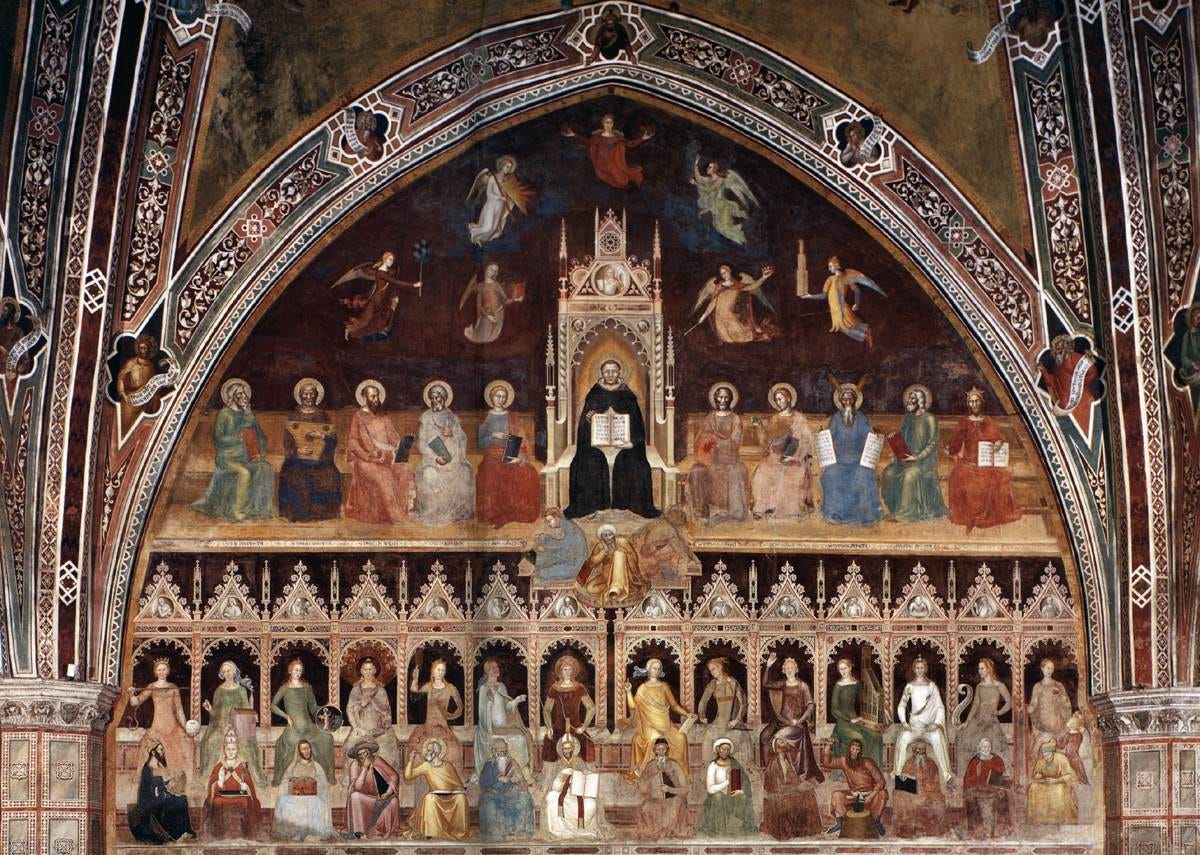
"In the first place, we divide education into religious and secular. The more devout among us insist upon religious education as well as secular. Many of us are content to do without religious education altogether; and are satisfied with what we not only call secular but make secular, in the sense in which we understand the word, i.e. entirely limited to the uses of this visible world."Many Christian people rise a little higher; they conceive that even grammar and arithmetic may in some not very clear way be used for God; but the great recognition, that God the Holy Spirit is Himself, personally, the Imparter of knowledge, the Instructor of youth, the Inspirer of genius, is a conception so far lost to us that we should think it distinctly irreverent to conceive of the divine teaching as co-operating with ours in a child's arithmetic lesson, for example. But the Florentine mind of the Middle Ages went further than this: it believed, not only that the seven Liberal Arts were fully under the direct outpouring of the Holy Ghost, but that every fruitful idea, every original conception, whether in Euclid, or grammar, or music, was a direct inspiration from the Holy Spirit, without any thought at all as to whether the person so inspired named himself by the name of God, or recognised whence his inspiration came." Parents and Children, chapter 25 (bold emphasis mine)
I think parents who have chosen to homeschool, who have walked into it willingly and with conviction and prayer, willing to embrace the financial sacrifice as worth it, are people who care intensely and as such are prone to become tired under the load of fear that they will fail their children or that all the things the doubters said will be proven right. So when these kinds of ads and products come around, they are either tempted to grab these beautiful promises like a drowning man grabs a life-preserver, or they long after them like Rapunzel’s mother for the witch’s greens, feeling like if they just had [fill in the blank] their kids’ education would be so much better, their kids might be so much better. And that is why I think it is despicable that curriculum companies’ use this kind of spiritualized language to sell merch. They are making promises that simply can’t be kept by even twelve full years of the prettiest, most virtue-promoting curriculum ever produced.
“…the seed in you of every virtue…”
It is not the curriculum (even if it is Christian and classical) that will make your child virtuous. It is the Holy Spirit working through love. Love is the power, the virtue if you will, behind the desire to be a virtuous person. It is the only power that can sustain moral virtue. Dante, in canto xvii of Purgatorio4, gives Virgil to say,
“…there’s no Creator and no creaturewho ever was without love – natural
or mental; and you know that,” he began
The natural is always without error,
but mental love may choose an evil object
or err through too much or too little vigor.
As long as it’s directed toward the First good
and tends toward secondary goods with measure,
it cannot be the cause of evil pleasure;
but when it twists toward evil, or attends
to good with more or less care than it should,
those whom He made have worked against their Maker.
From this you see that – of necessity -
love is the seed in you of every virtue
He spends the rest of the canto expanding on this, and I recommend it to you. He then continues into canto xviii, where Virgil explains to Dante,
"The soul, which is created quick to love,responds to everything that pleases, just
When the soul is wakened by beauty, he continues, longing seizes the soul, “never resting till the beloved thing has made it joyous.” Further on, Virgil tells Dante, “There is in you, inborn, the power that counsels, keeper of the threshold of your assent: this is the principle on which your merit may be judged, for it garners and winnows good and evil longings.”
We can love that which we shouldn’t love, and long for that which we shouldn’t want, but it is this principle – “the principle on which your merit” or moral virtue “may be judged” – is trained by rightly ordered love.
And again, we are back to Mason’s philosophy towards education, which is all about putting an abundance of good and beautiful things before the child so that their loves are rightly ordered. This is how Education functions as a handmaid to Religion, by teaching the child to care, to see the universe and everything in it as ordered and beautiful and connected to each other in a multitude of tiny ways. It is to see “the Love that moves the sun and stars” and extended to themselves not just through church and sermons but through all creation and all living ideas and expressions of truth and goodness and beauty.
This is why Charlotte Mason said a successful education is not measured in testable knowledge:
"The question is not,––how much does the youth know? when he has finished his education––but how much does he care? and about how many orders of things does he care? In fact, how large is the room in which he finds his feet set? and, therefore, how full is the life he has before him?" School Education, 170-171
Ordo Amoris
To strive for virtue is a worthy goal. I don’t want to make it seem as though virtue didn’t matter. But it cannot be the ultimate goal. We don’t homeschool or follow Christ so that we can become virtuous.5 Virtue is a by-product of love. When the Israelites were performing all the proper sacrifices but without love toward God, He told them to stop, that their sacrifices weren’t just unaccepted but an abomination. Our virtue is only worthy of Him if it is born of love. And as much as we may want to create that love in our kids, we can’t. No curriculum, classical or otherwise, can do that either. It is only the Holy Spirit who can produce that kind of love in our kids’ hearts.
We homeschool from a place of love first and uppermost; we follow Christ and obey His commands out of love above all other reasons. If it is not of love, it is not going to last. Education exists to help our kids learn to love what ought to be loved, and to love it rightly. This happens not only or even primarily through educational apparatuses like curriculums, conferences, or workbooks, but organically, through the home atmosphere, through discipline, and through all of life in general. Our kids aren’t the only ones benefitting from our decision to homeschool; many parents find that they learn to love subjects they hated when they were kids. Model love for the true, the good, and the beautiful. Love it yourself, let your kids see that love and appreciation. No program can take the place of a curious parent who is excited about what she is learning.
Both Dante and Mason were drawing on St. Augustine’s famous ordo amoris passage in The City of God. I’ll leave it with you in closing and with the encouragement to be wise as serpents when it comes to these CCE product claims. Whether we eat or drink or whatever we do, we want to do all to the glory of God, and the foundation of that is love.
“And thus beauty, which is indeed God’s handiwork, but only a temporal, carnal, and lower kind of good, is not fitly loved in preference to God, the eternal, spiritual, and unchangeable Good. When the miser prefers his gold to justice, it is through no fault of the gold, but of the man; and so with every created thing. For though it be good, it may be loved with an evil as well as with a good love: it is loved rightly when it is loved ordinately; evilly, when inordinately. It is this which some one has briefly said in these verses in praise of the Creator:
These are Thine, they are good,
because Thou art good who didst create them.
There is in them nothing of ours,
unless the sin we commit when we forget the order of things,
and instead of Thee love that which Thou hast made.”
But if the Creator is truly loved, that is, if He Himself is loved and not another thing in His stead, He cannot be evilly loved; for love itself is to be ordinately loved, because we do well to love that which, when we love it, makes us live well and virtuously. So that it seems to me that it is a brief but true definition of virtue to say, it is the order of love; and on this account, in the Canticles, the bride of Christ, the city of God, sings, “Order love within me.”
Augustine’s City of God, XV.22.
I’ve left off the name of the company out of charity, but no one is stopping you from googling this shockingly hubristic statement
Proverbs 21:1
https://webstersdictionary1828.com/dictionary/virtue
VIRTUE, noun vur'tu. [Latin virtus, from vireo, or its root. See Worth.] The radical sense is strength, from straining, stretching, extending. This is the primary sense of Latin vir, a man.]
1. Strength; that substance or quality of physical bodies, by which they act and produce effects on other bodies. In this literal and proper sense, we speak of the virtue or virtues of plants in medicine, and the virtues of drugs. In decoctions, the virtues of plants are extracted. By long standing in the open air, the virtues are lost.
2. Bravery valor. This was the predominant signification of virtus among the Romans.
Trust to thy single virtue
[This sense is nearly or quite obsolete.]
3. Moral goodness; the practice of moral duties and the abstaining from vice, or a conformity of life and conversation to the moral law. In this sense, virtue may be, and in many instances must be, distinguished from religion. The practice of moral duties merely from motives of convenience, or from compulsion, or from regard to reputation, is virtue as distinct from religion. The practice of moral duties from sincere love to God and his laws, is virtue and religion. In this sense it is true,
That virtue only makes our bliss below.
VIRTUE is nothing but voluntary obedience to truth.
4. A particular moral excellence; as the virtue of temperance, of chastity, of charity.
Remember all his virtues.
5. Acting power; something efficacious.
Jesus, knowing that virtue had gone out of him, turned - Mark 3:1.
6. Secret agency; efficacy without visible or material action.
She moves the body which she doth possess,
Yet no part toucheth, but by virtue's touch.
7. Excellence; or that which constitutes value and merit.
- Terence, who thought the sole grace and virtue of their fable, the sticking in of sentences.
8. One of the orders of the celestial hierarchy.
Thrones, dominations, princedoms, virtues, powers.
9. Efficacy; power.
He used to travel through Greece by virtue of this fable, which procured him reception in all the towns.
10. Legal efficacy or power; authority. A man administers the laws by virtue of a commission.
In virtue in consequence; by the efficacy or authority.
This they shall attain, partly in virtue of the promise of God, and partly in virtue of piety.
Translation by Allen Mandelbaum
Thanks to Anne Phillips for articulating this thought so well for me.


Comments
Post a Comment