The Knowledge of Love, A Fragrance of Life - A homeschooling mother's review of "Mothers, Children, and the Body Politic" by Nadya Williams
Summer is the time of year I get to read pretty much whatever I want. I’m not reading during the week for classes I’m teaching or kids I’m homeschooling, so I have about 12 weeks to focus on books I’ve been wanting to read all year. I purchased Mothers, Children, and the Body Politic: Ancient Christianity and the Recovery of Human Dignity by Nadya Williams when it came out last year and finally was able to read it in the first few days of June. I think everyone would benefit from reading it, so I’m sharing a review here. Nadya Williams is also on Substack and I highly recommend her account. Hers is a voice worth listening to.
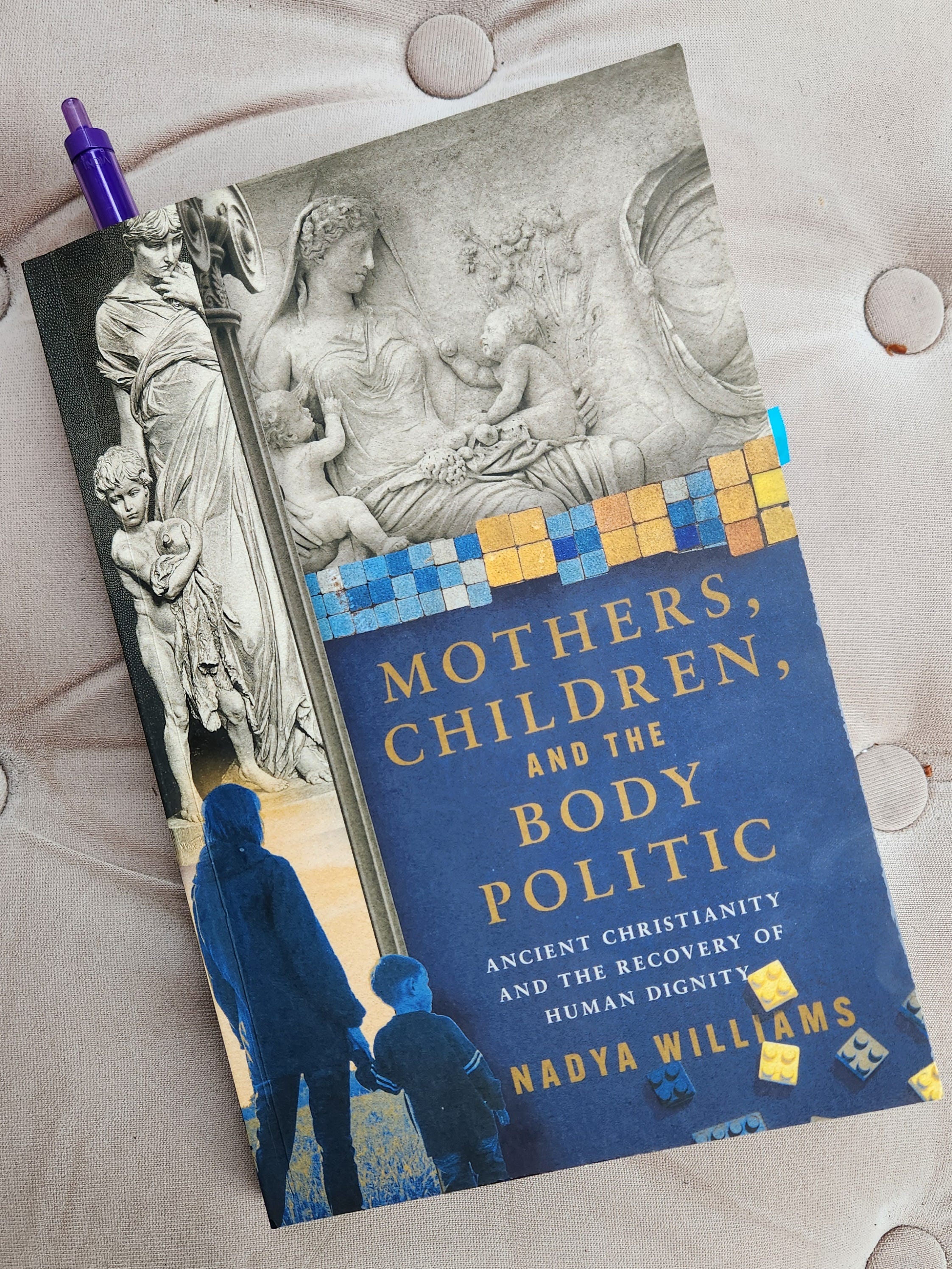
“…there is no denying that our surrounding culture is increasingly more hostile to motherhood and family.”
Nadya Williams
For we are the aroma of Christ to God among those who are being saved and among those who are perishing, to one a fragrance from death to death, to the other a fragrance from life to life. Who is sufficient for these things?
2 Corinthians 2:15-16
Having five children in tow at the grocery story always invites comments. They tend to range from “How lovely to see a large family!” (almost always from elderly folks) to “You sure must be busy!” to “Was your TV broken?” I’ve been asked if I’m Mormon (no), Catholic (no), crazy (jury’s out), or a glutton for punishment (uh…). People see you with several smallish people – or worse, pregnant with several smallish people - and they feel free to say whatever they think.
Once when my kids were 10, 8, 6, 4, and 2 (we did not plan it, but for six months of every year, their ages become an exercise in skip-counting), we were at our local grocery store and a woman took the time to stop me in an aisle of the store and say, “My goodness! Are these all yours?”
(Standard procedure so far.)
“Yes,” I said, smiling at my kids, who were behaving remarkably well. She had caught us on a good day, I thought. The children were as close to angelic as they had ever been. Clean and healthy – no smudgy, crumby mouths or snotty noses, everyone staying together and holding hands or the sides of the cart, patient and polite and not fighting… Really, we cut quite a figure, I thought.
“Oh honey,” she said, looking at me with genuine concern, “I feel so sorry for you.”
I was shocked. This was veering from the script.
“What? Why??”
“Because,” she said, glancing over at my kids, “You’ve made a lot of trouble for yourself.
I looked at my children, all watching me and being so good just then. What did she see that I didn’t? All I saw were five cute kids, five of my favorite people in the whole world smiling back at me. I smiled at them and said to her,
“Oh, I don’t think so. I like them a lot.”
“You say that now,” she snapped. “They’re young. They’ll change.”
“I’m actually looking forward to seeing who they become.”
She snorted.
“My kids became monsters.”
Now I was speechless. What does a person say to that? I tried to say something about how I was sorry to hear that, but she plowed on.
“They never appreciated me. They never appreciated what I did or had to give up for them. Now they won’t even make time to see me. They’re rude and selfish and awful. You’ll see. I’m sorry for you. I really am.”
“I’m sorry for you, too,” I said, “but I’m glad we had every single one of these kids. I wouldn’t do anything different.” I pitied her, but I was also angry. She was saying this about my children as though they weren’t standing right beside me, as though my 11- and 8-year-olds weren’t actively listening to this entire exchange.
The woman shrugged with a “don’t say I didn’t warn you” kind of attitude and continued down the aisle. As we watched her walk away, my oldest looked at me and asked, “How come she didn’t like us? She doesn’t even know us!”
“Yeah,” her sister chimed in, “and we are being really good right now!”
This was by far one of the worst exchanges I ever had with a stranger about our family size. Most people are socially aware enough to keep rude comments to themselves but this conversation has stayed with me. Why did this woman feel so free to tell me in the canned beans aisle that she thought these five kids of mine were a huge mistake and that she felt sorry for me? Aside from her own personal experience, which isn’t a very good reason, I think it is because the culture in general backs her up. This systemic cultural disdain for mothers and children is the subject of Nadya Williams 2024 book, “Mothers, Children, and the Body Politic.”
A Review of the Aim and Structure of the Book
In the introduction, Nadya Williams writes:
"My goal in this book is to push back against the acceptance of [the current] clash of worldly and Christ-centered values regarding human life, especially the lives of children and by implication mothers, in our society today, particularly in evangelical circles. Indeed, the devaluing of children is inextricably connected to the disdain our society conveys for the work of mothers - from the process of pregnancy to the work and resources expended on child rearing and education. In other words, our society has a built-in disdain for motherhood as a concept. So, I want to begin with an examination of the symptoms that we overlook in our body politic-those nagging body aches and mysterious rashes that we have lived with for so long as to not notice them. We have suffered them so long that we do not realize that anything is wrong, even as the body so desperately tries to tell us that something really has gone terribly awry. This was not how we were created to live, think, and perceive our own worth and the worth of other human beings."
Mrs. Williams’s approach to the topic of the devaluing of mothers, children, and the weak and vulnerable in our society is personal, as she explains in the introduction, and uniquely engaging because she not only outlines and diagnoses the problem; she shows that this devaluation is not a modern-era issue but a human-era issue. We have been devaluing those who seem outside the quantifiable and practically useful (and using pragmatic, materialistic definitions for those terms) since the Fall. Mrs. Williams shows this by weaving together stories from thousands of years ago with stories from today. Their similarities and overlap are uncanny and unsettling.
Further on in the introduction, she explains why she her approach to this topic is a worthwhile contribution to an ongoing conversation:
"This book contributes to the valuable dialogue that…other thinkers have started, but my chief contribution to this conversation comes in my capacity as a classicist and historian of the ancient world. The contrast between the pre-Christian Roman world and the values of the early church provides a striking argument for the role of Christianity in creating a wholly countercultural valuing of human life, no matter age, gender, social status, family connections, or ability level. This story, in turn, shows ways in which the recovery of these values of the early church could yet reshape our own society's blighted discourse on human life."
The bright spot in the book is the role the early church played in going against the accepted cultural grain, showing that another way is available to us, the way of love. The book is an encouragement for the church to actively reaffirm the vision of human dignity held up in the idea of the imago Dei, that every person has value and worth because they are an image-bearer of God Himself.
The book is divided into three sections, each with three chapters, with an introduction laying out the plan for the book and a conclusion to bring all the threads together. One of the things I most appreciated about the layout was that she has a “here is what I’m going to talk about in this chapter” paragraph or two at the beginning of each section and each chapter. Kind of like she was tracing the route on a map for us, telling us to watch for before we got in the car and made the journey. Then, at the end of each chapter she has a brief “here is what we talked about” conclusion, going over what she covered so far in the book and how it all fit together. It was very helpful for keeping the main ideas in mind.
I want you to see the flow of this book. It is interesting and thorough, and every chapter gives the reader a chance to hear distant ages speak, whether well-versed in classic Greek and Roman authors or not:
Part one is titled “Symptoms of the Disease” and the chapters are
· Devaluating Pregnancy, Childbearing, and the Maternal Body
· Your Assembly-Line Life
· Motherhood and Creative Work; Motherhood Versus Creative Work.
Part Two – “Views of Personhood in the Ancient Mediterranean Before and After Christianity” and the chapters are
· Worthless: The Devaluing of Women, Children, and Human Beings in the Pre-Christian Mediterranean
· The Useless Ones: Devaluing Civilians in War and Peace
· The Redemption of Useless People
Part Three – “Speaking Life into a Culture of Death”
· Consolation for the Weary Sufferer
· Seeking the City of God
· In Pursuit of Human Flourishing
Conclusion: Who is My Neighbor? Treasuring Children, Mothers, and All Image Bearers
There is never a moment where the old doesn’t sound modern and vice versa. In almost every chapter, Williams brings us back to the core question brought forward in the introduction: “What is a human life worth?”
"What is a human life worth if the doctrine of the imago Dei, the acceptance of the preciousness of every human life, is taken out of the picture?" (p.90)
As a pastor of mine used to say, “People are not as complicated as we like to think we are.” Of course, we are complicated, but sometimes, it is surprising to see how little a difference culture and millennia makes. We have had a pragmatic streak since our first mother saw the fruit of the tree as eminently useful.
I believe Mrs. Williams accomplished her goal to “push back against the acceptance of [the current] clash of worldly and Christ-centered values regarding human life,” and I think anyone interested in human life and human flourishing would benefit from reading this book. As Christians, we are called to be a fragrance of life in a culture of death. Nadya Williams brings that to the forefront of almost every chapter without condemning the church. Her language is gracious and an exhortation to each reader to fulfill our life-giving calling to love our neighbors as ourselves and to see in their face the image of our Lord.
Your Assembly-Line Life – my personal take-away from this book
I was expecting this book to be an extended exercise in nodding my head in agreement, but in chapter two of the first section, I was blind-sided by conviction. The chapter is titled, “Your Assembly-Line Life,” and I am going to focus on this part of the book for the remainder of the review.
I think homeschooling parents can sometimes feel like we are above or at least beyond the “materials-in; product-out” mentality of our culture. I know I am guilty of this at times. But something Mrs. Williams said in this chapter has been ringing in my mind since I read it, and especially now that we are in the heat of summer curriculum buying and school planning:
“Creating one’s child to be the American counterpart to ‘the best of the Achaeans’ is now the goal of many parents who have fully embraced the assembly-line model to molding their perfect baby into the perfect adult. Homeric-style excellence is expected in every activity, and second best is not an option – just ask the Tiger Mom. It begins already with expensive preschools and waitlists to get into them. Just ask anyone you know who has sent their child to the local Montessori preschool. It continues with the obsession with just the right model of schooling for the growing student -- and, by the way, homeschooling can be a part of this assembly-line vision just as much as public or private schooling. One does not have to send one’s child away to put them on the assembly line. We are perfectly capable of creating idols out of good things right here at home, thank you very much.” (emphasis mine)
When I read this, I had to pause and take a moment to recover. I recognized the truth of what she said immediately. And knowing that she is a homeschooling mother herself, I am sure Mrs. Williams was speaking as much to her own modern temptation to view educating her children in this manufacturing lens. But to have someone say it so clearly and unapologetically, without caveats or excuses – it felt like a cup of cold water thrown into my face on a hot day; shocking, but bracing and refreshing.
She goes on to say:
“Indeed, the current debates – or, if we are honest, outright culture wars – over education are really disagreements over what different parents consider to be the best assembly line for shaping our children. In the case of public education, in particular, the concern is with optimizing mass production. Children in public schools are objects to be shaped and molded into a particular product in a decidedly procrustean fashion. Don’t want this kind of assembly line? Parallels exist, including increasingly more expensive private schools or homeschooling. In some ways we could even consider the culture wars surrounding the different kinds of schooling, and the content to be allowed or banned in them, as wars over control of the assembly line.” (emphasis mine)
Look at any homeschooling catalogue or advertisement, read any blurb on a curriculum company’s Facebook page – I just wrote about this last week – and you will see the “money-in; product-out” approach. This is one hundred percent assembly-line thinking. This is homeschooling via formula, engineering instead of educating. This is not the goal.
Don’t misunderstand me. Every homeschooling parent I know started out formulaic. We had a vision of the kind of person we wanted our kids to become and by golly, we were going to do whatever we can to make that happen. Somewhere along the way, Lord willing, we find out that this is just is not how parenting or homeschooling works. Not at all. We have these small people to deal with who, we quickly discover, are totally different than ourselves, and who refuse to be molded by us. We think we are the potter forming clay, but it turns out we are just a larger lump of equally unmoldable clay. What’s a mother to do?
Speaking specifically about the new development of genetically engineering of an unborn baby’s body (she mentions a company that will allow you to choose your unborn child’s eye color and sex), Mrs. Williams writes, “…let us say that you do get everything you desire at this stage in the assembly-line process: the perfect newborn! …The problem is: this child will still disappoint. Any attempts to customize children deny the reality of human flesh. Children, like all people, are unpredictable individuals and are not made for the convenience of their parents. … This struggle to design the ideal baby ultimately reduces human beings – in this case, children – to objects to be shaped and molded to our own will and for our own happiness, rather than image bearers entrusted to our stewardship for a season.” This applies not just to parents trying to choose eye color; it is also applies parents trying to shape their child according to their own desires through homeschooling. We can’t design our kids. We can train them and guide them – and we must – but all while knowing that nothing is guaranteed, that they are their own persons, “image bearers entrusted to our stewardship for a season.”
Is the over-arching attitude toward our homeschooling one of a living education, focused on the child as a person, or a public-school-at-home/factory-style “materials-in; product-out” approach, focused on the child as a raw material in need of industrial shaping? It takes time and practice and a willingness to step out of the boxes we have put education (and our children) in and try something else, something more humane.
Is my Charlotte Mason showing? This is why I continue to believe more and more that the most humane way of educating our children was laid out in the early 20th century by Charlotte Mason, the British teacher and educational philosopher and reformer. She viewed the personhood of the child as central to a humane education. In the Preface to her 6 volumes, she writes:
“The central thought, or rather body of thought, upon which I found [a philosophy of education], is the somewhat obvious fact that the child is a person with all the possibilities and powers included in personality.”
Her first five points of her list of educational principles, which are listed in each volume, are:
1. Children are born persons.2. They are not born either good or bad, but with possibilities for either good or evil.
3. The principles of authority on the one hand and obedience on the other, are natural, necessary and fundamental; but
4. These principles are limited by the respect due to the personality of children, which must not be encroached upon, whether by fear or love, suggestion or influence, or undue play upon any one natural desire.
5. Therefore, we are limited to three educational instruments––the atmosphere of environment, the discipline of habit, and the presentation of living ideas.” Home Education (bold emphasis mine)
This is why Miss Mason relies on living books and living ideas rather than workbooks and things that would masticate ideas for the child. She believed – and having seen it in action in my own children, I think she is right – that if you give a child a well-written book about any subject to read (or if he is too young, if you read it to him), that child will learn and retain the ideas his mind most needs, or finds most compelling, and you as the parent simply don’t know what that is. Your child needs to come in contact with the knowledge itself so that he can take in what his mind wants, just as we give our child a plateful of food and leave the chewing, swallowing, and digesting to him. It’s not that we never explain or help our kids, but that we give them the opportunity to learn as they are made to learn. A child will learn and grow in knowledge if we give him materials he can learn from. There is more to her educational philosophy than that, but that is the starting point:
“One more thing is of vital importance; children must have books, living books; the best are not too good for them; anything less than the best is not good enough; and if it is needful to exercise economy, let go everything that belongs to soft and luxurious living before letting go the duty of supplying the books, and the frequent changes of books, which are necessary for the constant stimulation of the child’s intellectual life.” (Vol. 2 p. 279)
Mrs. Williams, talking about our modern, assembly-line approach to education – an approach to which none of us are immune – goes on to say:
“What is the ideal final product supposed to look like, think like, believe like? We cannot quite agree as a society, but we can agree on one thing: we want to control it, because it matters. Education, we see, is never neutral because knowledge is not. Whatever children absorb at this stage on the assembly line is going to mold their bodies, minds, and souls.”
The thing is, you can never control what your child absorbs, or doesn’t absorb. The most you can do is put them in the way of good things – lay a wide and varied feast for them, as Charlotte Mason says – and trust that they will take what they need. We can make education a part of our family atmosphere and model our own self-education (“Education is an atmosphere, a discipline, a life), we can listen to their narrations and as they grow encourage connections between subjects, but ultimately, the learning and their education is their own. As Charlotte Mason says, “There is no education but self‑education.”
Stepping off the assembly line
There is a way out of this modern manufacture mindset. We have to resist the temptation to think that our homeschooling is successful – that our children are living worthwhile lives – only if they are ivy league graduates or pursuing a lucrative career. These things are good in themselves, but they often become standards of success in the homeschooling world. When asked if homeschooling “works,” I’ve seen responses like, “My homeschooled kids all graduated from Harvard and have six-figure jobs.” Congratulations. But those parents whose kids worked up the ranks in Costco or pursued a career in welding at the local tech college can be tempted to feel like maybe we are less successful. Mrs. Williams has some good things to say about this, too:
“It seems that in our society, the assembly line, with its competitive ethos, does not end with college. It only keeps going for the rest of our lives. Selfish to the core, this ethos puts the idol of success first, far ahead of any family relationships, actual or potential. Is it any wonder that so many from the most recent generation of young people raised on the assembly line are by-passing marriage and children? Achilles and Augustus built their successes on corpses. Today’s best of the Americans might not do that, but their view of human lives, including their own, is not that much better. In competition, after all, there can only be one winner.”
This is why Charlotte Mason’s rubric for a successful education is so helpful. She knew many of her students would go on to be working men and women. Her education method was developed to give those men and women a wider scope, not just a taste of beauty and goodness but a taste for these things that would stay with them through their lives and make their lives more meaningful to themselves, more fulfilling:
“The question is not, — how much does the youth know? when he has finished his education — but how much does he care? and about how many orders of things does he care? In fact, how large is the room in which he finds his feet set? and, therefore, how full is the life he has before him?”
Her educational method was built around the idea that the soul of the student must be fed, and that if this is done, he will live a full life, rich in caring for the things and people around him.
A Purely Modern Idol
There is one point of difference between us moderns and the ancients that Williams brings forward, and that is our obsession with productivity:
"It is striking that while we as a society worship productivity in our own work lives, we have this same unrealistic and soul-crushing expectation of productivity of our children as well. This idol is thoroughly modern, on of our own making. The polytheistic ancient world, which had gods, major and minor, for what seems like everything – for instance, Cloacina, the goddess of the sewers of the city of Rome – did not have gods in charge of productivity or work in general. As part of embracing the idol of productivity, we use schools, to which we send our children to enhance our own efficiency in the workplace, to engineer our children as the best of the American."
The Solution
To close, I’ll give Mrs. Williams the final word. I highly recommend this book to you. There is much more in it than what I zeroed in on. Her approach to this topic reminds me of Lewis’s encouragement to read old books, “None of us can fully escape this blindness [of our present age], but we shall certainly increase it, and weaken our guard against it, if we read only modern books. Where they are true they will give us truths which we half knew already. Where they are false they will aggravate the error with which we are already dangerously ill. The only palliative is to keep the clean sea breeze of the centuries blowing through our minds, and this can be done only by reading old books. Not, of course, that there is any magic about the past. People were no cleverer then than they are now; they made as many mistakes as we. But not the same mistakes.”
Only sometimes, we do make the same mistakes as the people of the past. Nadya Williams’ book brings us “the clean sea breeze of the centuries” and helps us admit that its briny smell is rather familiar. But she also offers hope and encouragement for what to do, now that we know we aren’t all that different:
In her concluding chapter, Williams shares another mother’s awkward interaction with someone at a grocery store, and says, “Our culture devalues life in the simplest everyday ways, such as these grocery-store conversations.” She goes on to say,


Comments
Post a Comment